Thursday, October 02, 2014

Speed-the-Plow by David Mamet at The Playhouse Theatre


It has to be first - laminated summaries left on tables in the bar, so the audience know what’s happening onstage.  

The afternoon had seemed promising; I had a low priced short-notice ticket from an online group, the theatre was five minutes’ walk from Charing Cross, David Mamet is  playwright with a reputation for witty social comment. (His Glengarry Glen Ross (1983) won a Pulitzer prize).  The celebrity name set off vague alarm bells, but I’d been impressed by Kathleen Turner in Bakersfield Mist at the Duchess Theatre recently. (see below)

 Come the interval, though, I was retracing my steps up Northumberland Avenue. I talked myself round, and went back just in time to get a black coffee before the second half. After all, I told myself, I’d paid £4 for a programme.

 In the first act a lacklustre, barely audible Richard Schiff portrays  a newly -appointed Hollywood studio Head of Production, Bobby Gould.  His one- time assistant and rival, Charlie Fox, a convincingly brash Nigel Lindsay, makes you  hurt for every minute of the eleven years he’s spent toiling in the industry. By a stroke of luck he’s been offered a 24 hour option on a film script, a sure-fire box-office hit, and brought it along to his erstwhile partner in return for co-production credits. He knows Bobby is a ‘film whore’, interested only in a script’s money-making potential.  The two of them begin to speculate about the wealth the film will rake in.

Bobby’s temporary secretary, Karen, (Lindsay Lohan)  serves coffee and says a few lines in a voice as low and dreary as her boss’s. When she’s gone, Charlie bet Bobby that he wouldn’t be able to sleep with her before the following day.  On that gratuitous and unexpected  note the lights went down for the interval

The second half improved, mainly because Charlie had most of the lines, and some were memorable.  Karen the secretary has her own agenda, and is described by the disapproving Charlie, as ‘A tight pussy wrapped around ambition’ when he finds she has persuaded Bobby to give ‘the green light’ to a worthy but dull work with a downbeat theme. ‘I like Yellow Pages’, but I wouldn’t want to film it,’ says Charlie, as he senses his dreams of wealth are about to evaporate.  ‘Don’t let your dick run your office,’ he advises the smitten Bobby. For the final twenty minutes the theme of ethics  versus profit  emerges as the conflict between the two men develops;  there’s even a twist ending. Sadly, it’s too late.

Lindsay Posner’s direction is brisk enough, but Karen’s character is implausible and Lindsay Lohan quotes the book as if really is Yellow Pages. The two sets lack detail –a room with desks for Bobby’s office, and a room with a sofa and city-at-night backdrop for his apartment. Maybe the paperback play, offered for £7 when you buy the programme, would prove more entertaining. Otherwise, you could skip the first half and just read the summary in the bar.


Sunday, July 20, 2014

Culture Clash: Bakersfield Mist at Duchess Theatre, Aldwych .


I’ve too many bad memories of  West End theatres on hot afternoons.  So the cool freshness of the Duchess Theatre was a pleasant surprise, especially on a day when record temperatures were expected. Quite a contrast with the sun-drenched swelter of the Aldwych outside. 


Tom Piper’s somewhat spacious ‘trailer’ set  is stuffed with broken-down, mismatched furniture. At its  centre is an arm chair covered in a crocheted throw. Vaguely arty  coffee tables bearing  ‘objets’  crowd the floor; shelves and walls display painted plates and bright, tasteless paintings of clowns and weird seascapes.  It’s the home of loud-mouthed Maude (Kathleen Turner). ‘I decorated it myself, all from thrift shops’ she declares, in front of the horrified gaze of up-tight New York art connoisseur Lionel, (Ian McDiarmid) called in to evaluate a ‘find’. Maude is sure she’s bought a genuine Jackson Pollock for $3. If authenticated by Lionel, it’s worth millions. 


What follows is an hour and a quarter’s master class in how to deliver a two-hander, under Polly Teale’s smooth direction. Characters of different class, education and temperament are a good start.  The actors deliver a lively polemic on art while reliving the ups and downs of their respective careers in art-criticism and bar-tending.  Lionel’s demonstration of Pollock’s painting method, from arm-swinging flourishes to catching a coffee table he’s sent flying earns a round of delighted applause. A witty script does justice to the energetic performances.

I’d recommend buying the programme, which includes interviews with Kathleen Turner and Stephen Sachs as well as an eye-opening article about fakery in art, pictures, what’s-on news, a topography of Bakerfield and even a theatrically-themed crossword.

 
A cool experience in every sense of the word.

Saturday, May 31, 2014

Playing at it: The Pajama Game at the Shaftesbury Theatre


A musical based on a strike in a pajama factory where a manager falls in love with a union rep  sounds promising. Its first production in 1954 won countless awards and ran for three years.  'The Pajama Game' at The Shaftesbury Theatre has some excellent numbers, including ‘Hernando’s Hideaway’, ‘Hey there (you with the stars in your eyes) ’ and  ‘This is my Once a year day’. What  a shame the storyline doesn't live up to  the music.  Factory work isn't a game, at least not for the employees. 


Writer George Abbott based the script on a novel by Richard Bissell called 'Seven and a Half Cents'. The author says he was inspired by the warmth and liveliness of his family's factory in small-town Ohio, where he worked as a manager. The storyline follows the progress of an ambitious young man from Chicago, Sid Sorokin. Michael Xavier looks perfect as Sid, with something of a John Wayne manner and a strong voice. He’s also nifty on his feet, important in a show which excels in the choreography department. Joanna Riding as Babe, the feisty union leader, is suitably cheerful and flexible when it comes to dancing but her role is less convincing. There’s strong support from minor comic characters.


If the romance seems unlikely, the factory scenes have an undercurrent that works against the intended humour. The floor manager's efforts to speed up production with a stop-watch (‘Hurry Up!') as an opener,  robotic workers all flustered,  engage the audience from the start . However, the ‘Seven and a Half Cents’ number, where workers  imagine in turn what twenty years of the tiny pay rise could bring, mocks their aspirations and desire for consumer goods. The staging reduces them to cartoon-like figures. 

Richard Eyre’s direction is faultless and the songs are brilliantly staged. I can’t imagine a better production of the show. Arguably the theme has relevance, if only one of contrast  in an era where workers’ rights hardly exist, thanks to erosion of union powers. It’s a shame that real-life disputes aren't so simplistic, or settled so easily, as in ‘The Pajama Game’. 


Tuesday, May 27, 2014

Cityreads Quiz at Manor House Library


Teams  representing library reading groups and a library staff team met at Manor House Library on Tuesday 20th May at 7.30pm. We were all set to be tested on our knowledge of Louisa Young's My Dear, I've been meaning to tell you... and, incidentally,  on our knowledge of WW1 battles and artists. Wines and light refreshment were much appreciated.

The novel is a harrowing account of a young man's experience of  recruitment, fighting and injury  in WW1. That's about as much as I can say without spoiling the plot,  but the background story  is an inter-class romance. That is all established before the young man joins up, but it's the part I found rather dull and not very credible. It's when the fighting starts that it picks up. The author's research into a relatively specialist aspect of the conflict is impressive but very well integrated into a dramatic narrative. 

We'd already discussed the book in the Lewisham Main Library reading group that meets at 10.30am on the first Saturday of every month and agreed it was a worthy choice for the annual contest.


We were : Chris (in the spotted top) Sarah, Shirley and me. Like me, Chris is an ex English teacher but she has more of a memory for details than I have, down to the name of the hospital where the hero was treated, which helped us score well on the section about the text. Shirley is an ex Art teacher so was particularly good at identifying artists and titles in the section where we had to identify paintings by artists of the time. Sarah, the youngster of the team - was good at anagrams of WW1 battles and at saying things like 'Just a minute. Is that the real answer? ',  as well as supplying plot details.  To my surprise, recent visits I've made to Belgium, where my son worked for a while,  came in useful because I recognised scrambled names of towns I'd visited but the others didn't know. 

At  half-time  another team was in the lead, but  I have to tell you, dear reader, that we won. 


On Saturday we'll be discussing another book with a similar theme - Erich Maria Remarque's  horrific  account of the Great War told from the point of view of a young German soldier: All Quiet on the Western Front. 


Tuesday, November 26, 2013

The Art of Horror: Paul Bryers at the Writeidea Festival 2013


Lucky me.  Paul Bryers drew on his considerable experience as a film maker and writer on November 17th at the IdeaSpace in Whitechapel Road. (It's really a huge modern library near the Whitechapel tube station) His presentation was  called ‘The Art of Horror’.
A range of examples, from Bram Stoker to Stephen King were combined with  personal anecdotes. A sense of mischief is essential for a writer of horror, he said, referring not just to Roald Dahl’s short stories but his own childhood game of frightening himself by projecting a shadow with a torch onto his bedroom wall and then walk  backwards  so it loomed  larger and larger.

Location plays a prime role in horror stories, typically the archetypal haunted house, but a landscape can be as eloquent as a building. EdgarAllan Poe lived for a while in nearby Stoke Newington, and projected images of the place were overlaid with quotations that summed up Poe’s feelings when he lived there:
“I became insane, with long intervals of horrible sanity.”  He also had ‘tendency to see demons’

According Stephen King:   ‘We make up imaginary horrors to help us cope with real ones’. King’s film The Shining, set in a remote hotel in the wilderness of Maine, encouraged Bryers to spend three months there on an Indian reservation whilst preparing to write his own book, a firm believer in the theory that  ‘A lot of the things you write about come from places you visit’.
‘The essential of horror is coincidence’, he said mentioning the bizarre road accident that nearly killed King, when he emerged from a wood onto an almost deserted road into the path of a drunken truck driver. ‘Every moment we deal in chaos’


Paradoxically, Bram Stoker found the ingredients for his classic Count Dracula from his Summer holidays in Whitby, where he was inspired by the ruined abbey, and   house that suggested the home of solicitor John Harkness, and even two women at his digs who became fictional female victims.  He found the idea for his villain from a book about a Russian tyrant called Vlad the Impaler.
An exploration of Charles Perrault ‘s (1628-1705) classic fairy tale, Red Riding Hood showed the potent influence of a shape-shifting wolf on writers like Angela Carter,  Thomas Harris and Daphne Du Maurier.

The essential ingredients for the writer of horror stories could be summed up as: haunted locations; myths and fairy tales; evil characters; innocent/vulnerable victims; irony; predestination and coincidence; paradox; one’s own life experiences; a sense of mischief.

I’ll definitely be attending this weekend-long festival in 2014 and would recommend the talk if you see it offered elsewhere. It’s the best I’ve seen all year, and  especially good for aspiring  writers (like me).

Friday, November 22, 2013

In the Next Room or the Vibrator Play at the St James Theatre, Victoria


Sarah Ruhl's  piquant  comedy about medical treatment for ailing women in 1880s America explores gender issues and touches on the role of technology in sexual relations.
Dr Givings runs a successful clinic for depressed females in his middle-class home. A supply of the latest domestic modcon – Thomas Edison’s newly-available electricity – means he can deploy an apparatus that brings about a miraculous change in the health of his patients after only a few treatments.

Much of the humour in the play rests on the assumption that the Victorians didn’t know that the ‘paroxysms’ induced by direct stimulation were of a sexual nature. The spectacle of the straight-faced  doctor (Jason Hughes)  applying a buzzing contraption to his patient (Flora Montgomery)  lying under a sheet while he stands beside the couch with a stop-watch is hilarious; even more so when he extends his practice to include a local male poet (Edward Bennett) who has experienced a romantic disappointment. Soon everyone wants in on the treatment,  including Mrs Givings (Natalie Casey ), whether the doctor is present or not.
Laurence Boswell’s brisk direction and an experienced cast, added to authentic set and costume designs by Simon Kelly,  recall the satirical world  of Oscar Wilde and  George Bernard  Shaw, with similar ironic dialogue and comments  on social conventions.
 
Even they wouldn't have included the male full frontal nude, though, in a scene that seems tacked on to titillate, in line with the somewhat misleading  poster and programme illustration.
 
 
The glamorous venue in Palace Street is readily accessible by walking through the new shopping mall opposite Westminster Cathedral, and the same street has a very cosy Shepherd Neame pub, The Cask and Glass in the same street. There's a noisy gastro-pub next to the theatre itself, which also has a restaurant and cocktail bar.  
 
The stage  an has an unusual semi-circular curtain rail  that juts out into the small auditorium. Maybe this accounts for the ungenerous amount of leg-room. It made me glad there was  an interval even though I was well-entertained for the hour and forty minutes running time of the play.

Sunday, November 17, 2013

Disappointing Dramas: The World of Extreme Happiness and Mansfield Park.


Two plays I saw in October depicted women fighting social restraints;  they disappointed for quite different reasons.


The World of Extreme Happiness at the NT’s temporary space on the South Bank, the Shed, was about internal migration in China –peasants moving from the countryside to the cities in search of economic and social gains, often at great personal risk.

 It struck a chord with me; I taught in China in 2,000 on an English Language Summer School south of Shanghai, where a booming crime rate in a small town was blamed on incomers competing for jobs.

 Since  then a  whole spate of films in China such as Jia Zhangke’s docu-drama 24 City (2008),  Yang Ya-zhou’s  Loach is Fish Too (2005)  and others, depicted migrants caught up in a rush to cash in the economic boom. Their aim was to lift their families from the hardships of subsistence farming.  

 This raucous production at the Shed covered most of China’s problems for the last sixty years from the one-child policy to famines under Mao, a sometimes overwhelming context.   

Lowly heroine Sunny is desperate to escape the shackles of her gender. Unlike the migrants in the above-mentioned films her goal is to improve her own status. Presented as a contestant in a talent show with  a top job in the business world as the prize, her westernised outlook seems puzzling.
A visceral script and strong performances from the cast grabbed audience attention. Vera Chok as Xiao Li, alumna of self-help books, plays  a convincing Chinese Barbie who shows ill-fated Sunny ( Katie Lung) how to smile and dress for promotion. The remaining actors give strong support, especially Daniel York as the world-weary veteran of the Cultural Revolution with no sympathy for a younger generation who want it all and want it now. Bold staging and a raw script from Ya-Chu Cowhig make a case for a China’s nightmare present built on a horrific past.

It’s sad to think the values of a society steeped in traditional values of hard work, patience and above all family ties could be overturned so quickly. Programme notes, however,  reveal little direct experience of mainland China by cast or writers.


Like most people, I’m long-time admirer of Jane Austen’s satirical portraits of her age and social class;  I’ve recently been preparing a course about adapting Jane Austen novels into film.

Mansfield Park is a favourite Jane Austen novel, despite the insipid heroine, Fanny, and her love-object the equally pale and loitering (thankfully off-stage for most of the play) Edmund Bertrand. I like the broader social canvas shown in Fanny’s home in Portsmouth. The plot recognises a largely ignored factor in Austen’s novels: dependence on the West Indies slave plantations to support the great English estates.

Fanny, whose aunt married higher up the social ladder than her own mother, is taken from her family in Portsmouth to be raised in the luxurious surroundings of Mansfield Park. When she refuses to marry the man chosen by her benefactor, Sir Thomas Bertram, she is returned to her chaotic seaport home. A spell of poverty may bring her to her senses and remind her of a debt of gratitude she owes to her benefactor Sir Thomas.

The Bury St Edmunds production adapted by Tim Luscombe seemed lost in the huge shallow soup dish of the Rose Theatre, Kingston, where it played at times like a Greek Tragedy. Much of Jane Austen’s action happens typically in drawing rooms, hedged-in garden walks or crowded assembly rooms (contrary to what the films depict). Here a vast space accommodates statuesque figures who never really come to life. Worse, some of the cast, especially the gruff-toned and admirably tall Sir Thomas Bertram, (Richard Heap) were at times inaudible. He was better as bluff Mr Price, Fanny’s seafaring father.

The adapter says he wasn’t sure where to put the interval, but the first half was soporific and the play only took off after the interval. I'd begun to think Portsmouth would be left out. Thankfully, the actors doubled up to play different roles in the contrasting family. Geoff Arnold was remarkably transformed with the help of wigs and costumes from Tom Bertram, ne’er-do-well son, and the ebullient Mr Rushworth, to Fanny’s beloved sailor brother,  William. Kristin Atherton made a lively Mary Crawford, plainly disdainful of clergyman Edmund’s chosen profession, and as Fanny’s sister Betsey.
How to make a drama from repressed emotions and genteelly-expressed opposition is a challenge, especially in such a large theatre. One answer to the staging problems presented by Mansfield Park may well be to heed Willy Russell’s Rita’s advice, and ‘Do it on the radio.’


Sunday, October 06, 2013

I ♥ Literary Events


I love going to authors' talks and writing workshops. But much  as I like to blog about them, it's sometimes hard to catch up. September and early October seem to be the worst months.
 
 On the 16th I enjoyed 'Found in Translation' at the LSE, in the splendid Khalili Theatre. Novelists Ali Smith, Julian Barnes and Adam Thirwell, plus  Sandra Smith ( translator of Suite Française) discussed the art and importance of translation, and the perils of Anglocentricity to  a packed house. It was arranged by The Royal Society and produced exactly the right mix of personalities to be entertaining.
 
I somewhat naively began to learn foreign languages because I thought I'd learn to read foreign books in their  original form. The  best I achieve as a rule is to prepare for classes with the help of a parallel text, or a translation.  I once read 'Madame Bovary' in French on a long holiday away from foreign bookstores, (it helped that I'd already ready that in English) but reading Marquez's  '100 Years of Solitude' at a rate of six pages a week in a Spanish class, although interesting, is more torture than pleasure. Although there's something to be said for such a slow approach to a very rich  and complex text.
 
I didn't have to go far to get to the LSE, and indeed I don't have to leave London to get my fill of talks and workshops. But I also  like to travel beyond the M25.
 
 
On the 19th I attended two events at the Woodstock Literary Festival. I didn't have time to  visit  Blenheim Palace, which can be accessed from the village , but I did take a lunch-time coffee at the Oxfordshire museum in the main street.


 It's  a modern building and has an art gallery as well as a garden. I ate my sandwich on a bench alongside the old town stocks, opposite the church where I heard Ruth Rendell talk about her latest book  and answer questions about her life as a crime writer. In the same café I overheard someone say she could be 'tetchy', but when I asked her to pose for a photo she agreed at once, and suggested we move to a lighter bit of the church when the first attempt came out  blurred. Now I'm a bigger fan than ever.


In the afternoon I went to another church to hear an intriguingly title talk called 'How to be Female and Awesome in the Modern Age.' Journalist and broadcaster Melissa Benn, popular Guardian writer and columnist Hadley Freeman, and documentary-maker turned writer Polly Morland talked about how women should live their lives in the 21st century, what the constraints are, and whether it is still a man’s world. They came to a generally pessimistic conclusion.
 
This visit took its toll on the coffers as I bought all three of the books on offer.
 
 
Benn’s What Should We Tell Our Daughters? The Pleasures and Pressures of Growing up Female confronts the casual sexism that still meets young women growing up today, from the avalanche of unrealistically skinny models who depend on their looks for success, to inequality at home, at the office and in pay. Benn’s journalism appears in many national newspapers and magazines, and she has written and presented several Radio Four programmes.


Freeman’s latest book, Be Awesome: Modern Life for Modern Ladies, tackles subjects vital to any modern woman. Discussion ranges from ‘How to read women’s magazines without wanting to grow a penis’ to topics such as ‘Beyond the armpit: a guide to being a modern day feminist’. Freeman writes the Guardian’s Ask Hadley fashion column and contributes to US Vogue.


Product Details

Morland''s first book, The Society of Timid Souls: Or, How to be Brave,  has been longlisted for the 2013 Guardian First Book Award. She looks at what courage means for women today.


At least I didn't buy any books at the  short story masterclass I attended on Thursday 3rd October, part of the Havant Literary Festival. I  was curious to revisit an old haunt. Fifty years ago, when my husband was a student in Portsmouth, one of  the jobs I did was in a factory in Havant. I learned to solder components onto circuit boards round a big table with  some very lewd women, a short-lived experience because I was useless at it - soldering,  not lewdness. I was only eighteen.
 
The Plessey factory has closed long ago, or so I was informed in the friendly group of a dozen or so writers assembled in the card room of the Conservative club on the Emsworth Road. It didn't strike me at the time, but in the tea-break I found out that  Emsworth has connections with PG Wodehouse. In fact, a member of the group  who lives there said she wants to organise an Emsworth festival next year.
 
Although living in London means I'm spoilt for choice when it comes to writing groups, I envied these writers a  sense of cohesion, and the way in which they mentioned local writing circles and locations with the confidence that their hearers would know them. Exotic local names such as Liphook and Waterlooville stirred my own memories.
 
 Havant is no  more picturesque than I remember, especially in the rain,  with a  windswept and almost deserted shopping centre. When I called in at the Spring Heritage Centre to take my bearings and zip up my jacket,  though,  I wished I'd had more time to enjoy the exhibits. I did get time to look at a mock-up of a 1950s kitchen and a machine for cutting out leather gloves.  


The venue for class  was the card room of a  local Conservative Club, which resembled, appropriately enough, a colonial residence.  
 
 
The  camaraderie  made it go well. After introductions we  were given and discussed  information about short story  markets and requirements. Tutor  Carol Westron, a published short story writer,  was a friend of  women's fiction  doyenne Della Galton and passed on a list of tips gleaned from Della's work as a competitions judge. Carol herself has worked with groups of disabled writers, so perhaps it's not so surprising that many of the assembly came from similar backgrounds, with an interest in the therapeutic value of creative writing. She's a good  teacher - enthusiastic with  a sense of fun and a very encouraging manner.
 
For the active writing part of the three hour session we chose names from different kinds of dictionaries. Having  read a lot of  Jane Austen recently, I opted for a dictionary of eighteenth century name.  After writing detailed descriptions of appearance and preferences of  a  male and a female character, we chose opening lines  from lists and and constructed opening  paragraphs which we read aloud.
 
At the end of it I had the beginnings of a short story in the historical romance genre, with a heroine called Phoebe Foster. Later, on a train  that stopped at every station between Havant and Victoria, I secured a whole table for my own use and  revised the opening of a story I'm writing on for a competition.
 
 
The latest event took place yesterday, and this time not far from home  - a talk at King's Place, York Way, by the marvellously flamboyant and entertaining Jung Chang, author of 'Wild Swans' and 'Mao: The Untold Story'. She was talking about Empress Dowager Cixi, the subject of her latest book, which was recently chosen as 'book of the week' and read in instalments on BBC Radio 4.
 
Two notes to self : a)  put into practice in my own writing what I've learned from the speakers, and b) keep up with blog posts so I can give each event the coverage it deserves.


Tuesday, September 17, 2013

The Quiet Charms of Santander


'Reassuringly urban', was my husband's response to the city where I chose to celebrate my birthday.  I wanted to stay in a more authentic Spanish city than the usual magnets for foreign tourists and I guessed I'd have a better chance to put my language studies into practice.

I'd spent my 50th birthday in  Australia, and my 60th in China. I was working abroad both times, and money wasn't really a consideration, but ten years on it was.

When I came back I was  invited to write a 300 page review of my stay, in return  for a $20 discount on my next holiday booked with CheapO air.  There was no pressure to write a 'positive' review but  in fact there wasn't much to complain of.

Here it is, with added photos, as they weren't required for the review:

The Quiet Charms of Santander

Santander, on Spain’s ‘Costa Verde’, is not a place that flaunts its charms. Be warned, you’ll need to speak and understand some Spanish; you won't find bars offering an all-day 'full English’ . Sit in one of the many  bodegas, enjoy a tasty pincho with a glass of wine or ‘chocolate y churros’ and watch  the people pass  by. A surprising number  are elderly couples, hand in hand.


Collect a map from one of the rival tourist offices near the covered Mercado de L'Este,  one of the few places  where they do speak English .
 
While you discover the variety and interest of a modest Spanish city on foot, be sure to take a tip from the locals and carry an umbrella.


On sunny days, take one of the cheap and frequent buses to the beaches at Magdalena or El Sardinero  for a walk along the beaches.

 
There's a highly enjoyable collection of paintings and mixed-media installations at the free Museum of Modern Art,

and a well- preserved bullring at the Plaza de Toros. 


Ferries from Portsmouth dock at Portocchio, and you can stroll along the marina to the Maritime Museum and the area around the Palace Theatre.

 
Squares and statues give a sense of the city's  history.
 
 
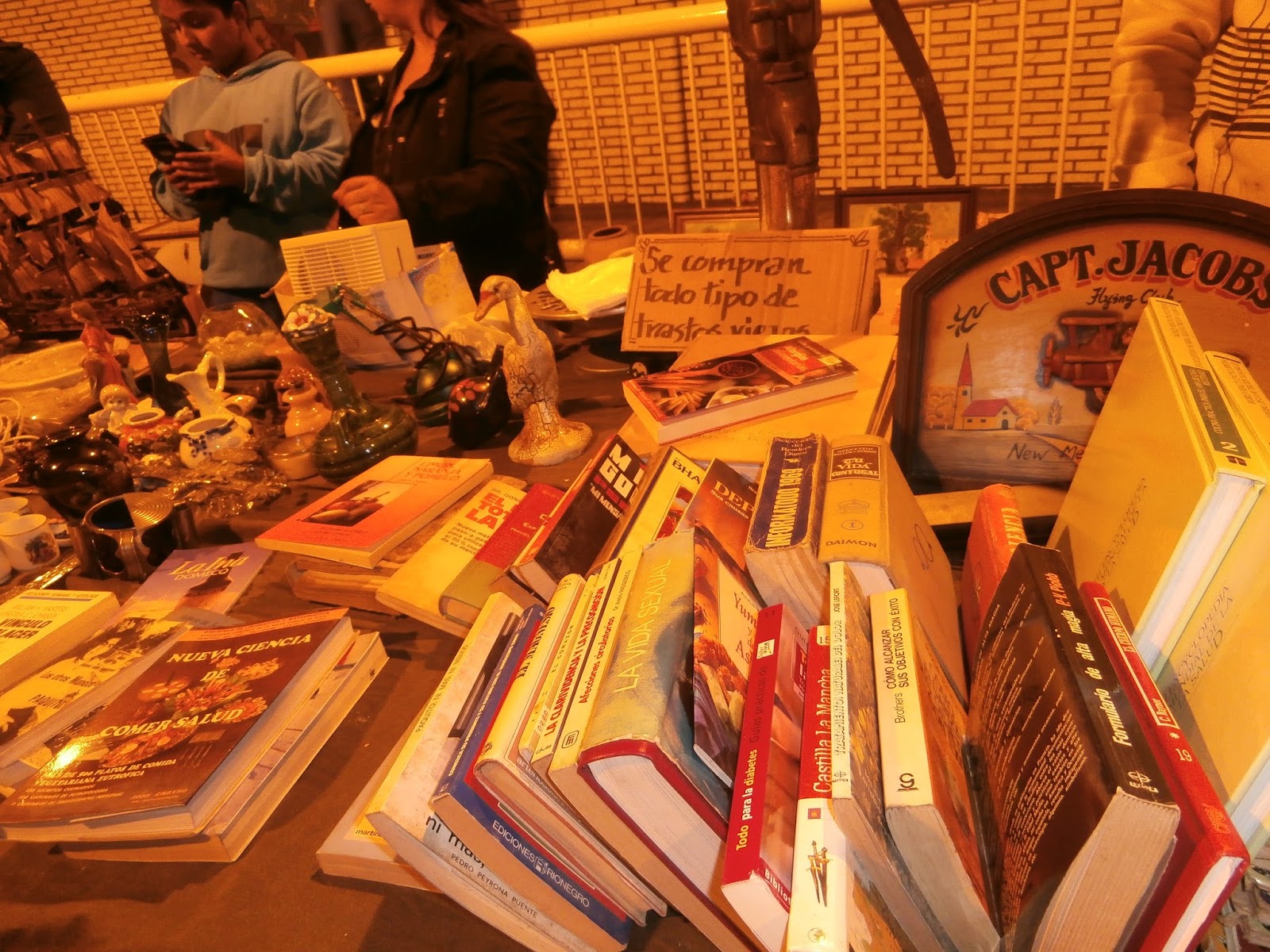
On Sundays visit the extensive (and cheap) flea market,  in the tunnel near the bus station that's  packed with traffic for the rest of the week.


Next year (2015) Santander will host an international yacht race competition. If you're lucky enough to be there in October you can catch a performance of  'Los Miserables' (sic) 

 The Ayumiento, (town hall) Correos (main post office) and  Cathedral have an understated charm that seems to sum up the mood of the city. Despite all the expensive shops with 'liquidacion' signs in the window, the citizens have a quietly stoical air about them.
 
If you fail to spot the pavement plaques indicating directions to the ancient Camino of Santiago, you won't miss the splendid triumphal archway of the Santander bank head office facing the sea,  surmounted by a  Spanish flag (at the top of this post).
 
 The best things about Santander?
  • cheap, reliable buses
  • clean streets
  • a peaceful ambience
  • 3-course menus del dia at 9-10 euros includes bread and half a bottle of wine per person
  • Lots of pedestrian crossings with illuminated displays and a countdown to show when to walk or how long to wait.
  • the airport is only a fifteen minute ride away from the main bus station.
  • With only one plane an hour on the day we left, it must be one of the world's calmest.


And the downside? 
  • the weather
  •  Not a single cinema , although the tourist office man said one was 'under construction'. 
  • A dearth of public swimming pools. The only one that wasn't for private members demand you ring in advance to book and they charge 8 Euros for an adult swim.
  • The demographic weighted towards the elderly, so it can seem a bit staid.
  • No nightlife after about 10pm, when the tapas bars close.
  • Nothing that I'd call a park.   
For such a flat place, there were very few bikes, although I spotted a Boris-style parking dock along the marina. So it was a pleasant change not to be plagued  by wheels whizzing along pavements or alongside traffic. There was a path marked out for them along the maritime walkway.

We stayed at Estudios Aranzazu, in a side alley off one of the main streets, basic but clean,  and flew Ryanair from Stansted.  'Ugh!' was the normal reaction when I told people, but the flights, one hour and forty minutes were comfortable and  cost only £170 return for the two of us, including reserved seats on the aircraft. The coach fare from Victoria to Stansted was £18 each, return.  We took only cabin bags, and paid less than 3 euros each for a bus to the centre. A taxi to  Estudios Aranzazu cost 4 euros but we walked to the bus station coming back -about 15-20 minutes. The accommodation cost less than £300 for two people.

I spent  relaxing week reading and walking an  getting to know a different city, at a bargain price . It made me really appreciate London's cultural amenities -although the weather here's  even worse!

Sunday, August 18, 2013

Not as silly as it seems: 'The Ladykillers' by Graham Linehan and Sean Foley at Vaudeville Theatre


The play I saw at the Vaudeville last week is a revival of the classic 1955 Ealing comedy directed by Alexander Mackendrick. That it all seemed a bit lacklustre was not for want of any acting ability by the cast, although it didn’t help that my friend and I had seats in the back row of the stalls. Some of the dialogue was lost.  

The idea for the film screenplay came to William Rose in a dream: five criminals, intent on seizing money from a delivery van at Kings Cross, plan the heist in a house near the station.  A sweet old widow called Mrs Wiberforce rents rooms to the leader, Marcus, who poses as a Professor of music and leader of a string quintet. The heist is to be planned under cover of ‘rehearsals’ with the old lady as an accessory to the crime, although she doesn’t know it.

Adding to the comedy is a noisy parrot called General Gordon, an  incompetent and ill-assorted gang and Mrs Wiberforce's tea-drinking cronies, all keen to hear the group’s rendering of Boccherini minuets -  really a decoy gramophone that disguises the gang’s plotting.  


Michael Taylor’s set is superb – a tumble-down, bomb-damaged house like a shambolic cuckoo clock, all parts jiggling when a train clanks into Kings Cross.

Less successful is the robbery, depicted on a board with moving lights to show the van intercepted and the getaway cars. A trunk full of money at the station is to be collected by Mrs Wilberforce, on behalf of her lodger. In the film with the advantage of a high point-of-view shot as the professor watches from a bridge, it’s much clearer.

Angela Thorne makes a perfectly credible naval officer’s widow, but she’s wasted in a role cut short because so many of the original film scenes are missing. A series of running gags, such as the old lady constantly standing on the Professor’s long scarf and a pivoting blackboard that always catches a gang-member a blow, become tedious with repetition.
 

What the play lacks most is the location shooting around the King’s Cross area. Much of the film’s charm is derived from the police station, the back streets and corner shops as well as the station itself. It’s as essential to the atmosphere as the iconic station in  another classic of British cinema, 'Brief Encounter'.
The film image of Alec Guinness and Herbert Lom on a bridge dangling a body by the ankles as they wait for trucks to pass underneath, the final drop swathed in steam, is unforgettable. The robbery scene with head-scratching porter and  out-of-order telephone box, plus the final coup-de-grace delivered by a falling signal, are delights the stage version fails to match. Someone I spoke to about the film remembered Frankie Howerd's cameo as an exasperated street stall owner.


As the actors took their bows, my companion said the show was ‘delightfully silly’ and I more or less agreed, until I read the director’s programme notes:
‘the Major, a conman, is a caricature of Britain’s decadent and ineffectual ruling class, One-Round is representative of the used, brutalised masses, Harry is the worthless younger generation, Louis the dangerously unassimilated foreigner, and Marcus embodies the collapse of moral and intellectual leadership.’
Given the widely diffused irony and social comment in British films of the era – continued in TV series like ‘Dad’s Army’ – it’s a shame the stage play didn’t bring this out.

Sunday, July 21, 2013

Fixing the Fluffs: 'With Great Pleasure' at the BBC Radio Theatre


Since my days  of acting in and directing  ‘amdram’ plays,  I’ve been fascinated by the backstage process, and I’d applied a few times to attend recording sessions at the BBC Radio Theatre. At last I succeeded in gaining  tickets to two programmes in the ‘With Great Pleasure’ series, recorded on July 7th.  
 

Maybe the  fact that the Wimbledon Men’s Final was played on that day played helped  my luck with  the ticket allocation. Although we arrived a half hour early, the café ‘holding’ area was packed and  our tickets were numbered 2003 and 2004. We were among the last to be called and just about managed to squash into gallery seats.

 
Celebrities in turn select favourite pieces of poetry and prose, interspersed  with reminiscence about their own careers. Hannah Gordon was first – a  tiny  Scotswoman I remembered from ‘Watercolour Challenge’, a programme I was addicted to when it first aired. Contestants painted scenes in UK beauty spots for five afternoons, overseen by Gordon, and on the Friday an expert awarded a prize of a box of paints.

The chosen poems, and details of Gordon’s experience at a dour boarding school, were delivered in her characteristically gentle style, although the opening poem, ‘Albert and the Lion’, read by Michael Pennington, needed a more robust sense of humour.
 
Each celebrity is accompanied by  two readers, which  in Gordon’s case were Pennington and  Eleanor Bron. Their  voices admirably suited poems, by Wendy Cope, Noel Coward and  Siegfried Sassoon. Gordon herself read a charming anecdote from Willy Russell’s ‘Shirley Valentine’, called ‘Nativity Play’.
 
 
 Lenny Henry proved more immediately topical, not least to me because I saw him play the lead in a 1950s American play called  ‘Fences’ just the other week (see below). As well as performing a speech from that play, he called on Nadine Marshall to read from Andrea Levy’s ‘Small Island’ - Hortense’s shock when she arrives from Jamaica and sees the tiny room in a run-down lodging house that is to be her home. 'Hortense's story is my mother's story', said Henry.


Extracts from Neil Gaiman’s ‘Anansi Boys’, Dickens ‘Dombey and Son’ and  Shakespeare’s  ‘Othello’  were all well received, as was  Jude Adekediki reading  an extract from Nigerian novelist Chinua Achebe’s ‘Things Fall Apart’.


I like the strong contrast between the two sets of extracts  and the presenters –one subtle, heart-warming and gently humorous, the other more vividly dramatic, and more political.

 
I listened to the first of the series last Monday afternoon,- Lenny Henry's programme -  and enjoyed it as much at the second hearing.
 
What you don't get from the broadcast performance, though are the ‘fluffs’ -the bits that have to be re-recorded because the actors have stumbled over their words. Efficient female producer Mary Ward Lowery,  took notes and made the cast repeat their lines - remarkably few of them in fact, although I felt sorry for the young actor who struggled with Achebe's convoluted prose style. At a stroke the seemingly confident  performers who, moments before, commanded  the stage, became schoolchildren  forced to repeat lines until they got  them right.
 
 'It sounds a bit flat,' remarked Hannah Gordon about one of her repeats . The producers's reply was brisk:  'Well, liven it up then!'.  I thought this was one of the most enjoyable afternoons of the year so far.