Wednesday, November 10, 2010

Not Very Satisfactory: An Ideal Husband by Oscar Wilde at the Vaudeville Theatre


Wilde's The Importance of Being Earnest is one of my favourite plays - the aristos are ridiculed in the best English literary tradition. But watching An Ideal Husband made me sympathise with Lady Bracknell's horror of babies in handbags - not because it smacks of 'the worst excesses of the French Revolution', but because it glosses political corruption, as 'youthful folly'.


London in 1891: Sir Robert Chiltern MP, who made a fortune selling privileged information when he was young, is being blackmailed by Mrs Cheveley, a woman in possession of a letter that proves his guilt. If his high-minded wife finds out she'll divorce him and he'll lose his Under-secretary post.

Set in the opulent gold-walled, marble-floored 'Octagon Room' in Sir Robert's house in Grosvenor Street and the stylish Curzon Street home of his dandyfied pal Viscount Goring, the design by Stephen Bromson Lewis is top-notch. The costumes are the best I've ever seen.

The pace is slow in the first half, where supper party guests lounge about in elegant clothes and complain of boredom, in slowly-delivered aphorisms: 'Questions are never indiscreet, but answers often are', 'One should always play fairly when one has the winning hand' and 'To love oneself is the start of a lifelong romance'

The second half is more invigorating, with unexpected visitors, mysterious letters and concealed eavesdroppers. The tainted Lord should get his come-uppance, but alas it's a case of art mirroring life. Oscar Wilde forgets his own definition of fiction, which demands that the good are rewarded and the wicked are punished.


The acting is good, especially by Caroline Blakiston as waspish dowager Lady Markby who might be Lady Bracknell's sharper-elbowed sister, and Samantha Bond as the beautiful worldly blackmailer who wants wants to be restored to fashionable society. Elliot Cowan as Goring had the best lines as the author's mouthpiece, as well as the most flamboyant suit.

Monday, November 08, 2010

The Country Girl by Clifford Odets at Apollo Theatre


My hopes for this play were mostly fulfilled.

I love to see a good solid classic play, especially when I don't know the plot. Clifford Odets' name crops up in association with Arthur Miller, whose All my Sons, starring David David Suchet and Zoe Wanamaker, I saw a few weeks back. I'd read he was a contemporary of Miller's, closer to him in tone and style than lightweight Neil Simon, whose Prisoner of Second Avenue , with Jeff Goldblum, I'd only half liked recently.

I've long been a fan of Martin Shaw's, not because of the TV series Judge Deeds which I haven't seen, but his wonderful performance as Macduff in the Polanski-directed film, Macbeth.

The plot is fairly straightfoward: In 1950 alcoholic actor Frank Elgin (Martin Shaw) is all washed up. Young director Bernie Dodd(Mark Letheren) remembers Frank at the height of his powers and wants him to lead a new play he's taking to New York. Despite producer Phil Cook (Nicholas Day)'s doubts Frank is persuaded to take the part, but insists his wife Georgie(Jane Semour) stays to support him for the trial-run in Boston. The action mainly takes place backstage at the two theatres where Georgie and Bernie are at odds about who exactly is pulling Frank's strings. In fact, Bernie accuses Georgie of 'riding him like a broomstick'. How soon will Frank fall off the waggon?

All-round the acting was very good, with two strong leads. This is the third time I've seen Jenny Seagrove in this year, once in Bedroom Farce and in A Daughter's a Daughter, the latter allowing her to show her versatility in a role where she transforms from dowdy wartime mother to selfish Honeysuckle Weekes in the first half to brittle partygoer in the the second. Here she's just dour and long-suffering, all on one note.

Maybe that' why I didn't like it. The play also dwelt too much on the theme of the wife sacrificing her own happiness for the sake of her husband.So it seemed a bit dated.

Tuesday, October 12, 2010

Fond Memories :Krapps Last Tape by Samuel Beckett at the Duchess Theatre


Every year on his birthday Krapp, now 69 and an unsuccessful author, makes a voice tape recalling highlights of the previous year. A scruffy alcoholic ('1700 hours on licensed premises') he's enjoyed a string of relationships with women and replays a tape made thirty years earlier, describing a sexual encounter in a boat. His monologue, punctuated by fits of anger and drinking, expresses regret for a 'misspent' life devoted to words. As he listens to his early voice he says it's 'hard to believe I was ever as bad as that.'


Michael Gambon is a perfect choice for this play, which has long stretches of stage 'business' while Krapp shambles about the stage eating bananas, absent at intervals when liquid being poured into a glass sounds offstage, opening and shutting drawers and messing about with spools of tape. Gambon's slow gestures and immobile face, the mouth almost permanently agape in a surprised O, his wild hair sticking out above raddled cheeks, presents a touching portrait of disillusioned old age. The sudden rages which scatter boxes and tapes are all the more striking because Gambon is a big man.

At 50 minutes with no supporting work - Beckett's shorter plays are often performed in pairs - this would seem poor value for anyone paying full-price for their seat. On the other hand, Michael Gambon's performance on a stage minimally furnishes with a table and chair under a single spotlight, is remarkable.

As a rule I don't rub shoulders with the famous, or even the moderately well-known. But I do remember a time when Michael Gambon bought me a pint. in the late 1970s I directed annual musicals at a girls' school in Camberwell - joint sixth-form productions with Archbishop Tennyson's school for boys at The Oval. Gambon's son played in the orchestra - I think it was trumpet. Maybe it was Gilbert & Sullivan, the deputy head's favourite, or Oklahomah, which I was allowed to direct in my final year at the school.

I crossed Camberwell New Road to the pub after the last performance, was warmly greeted and congratulated by the great actor and asked what I'd like to drink.

It's something I've been reminded of every time I've seen him in a stage production, from Shakespeare to Alan Aykbourn. Most recently he's appeared in four Harry Potter films.

For me his most memorable performance was in the title role of Dennis Potter's The Singing Detective on TV. His nervous anticipatory monologue then, as 'nurse' Joanne Whalley massaged cream into his psoriatic skin, contrasts with the poignant regret of the current performance. Gambon has the great classic actor's gift of conveying complex emotions expressed in poetic language.

Wednesday, September 15, 2010

All My Sons at the Apollo Theatre, Shaftesbury Avenue


Although this is not Arthur Miller's masterpiece ('Death of Salesman' is better) I can't imagine a more successful revival. A strong cast, Howard Davies'direction and William Dudley's design are all of a very high standard.

The magificent set includes the complete facade of a southern mansion complete with verandah, establishing a 'Gone With Wind' atmosphere. Only the presence of a 'yard' with furniture and picket fence tells you it's no plantation but the home of a successful businessman

A fringe of overhanging boughs occupies the width of the stage front. They sway in the wind and lightning of the first scene, with it's final symbolic crack that fells a tree. It's the most startling opening sequence I've seen. The ensuing drama slowly unfolds to reveal a message about personal actions and public responsibility. It's unfortunately sometimes swamped by mystery, melodrama and extraneous characters.

The action takes place in 1947. David Suchet plays factory-owner Joe Keller, who has prospered from the wartime manufacture of aircraft parts. He lives in comfortable retirement with his wife Kate, poignantly played by Zoe Wanamaker.

Their fighter-pilot son Larry was killed in the war. Kate still believes her son is alive, although he was reported missing three years ago. A family crisis looms as Chris and Ann, Larry's ex-fiancee, played by Jemima Rooper, reveal their plans to marry.

Although presenting a jovial face to his neighbours and to his visiting son Chris (Stephen Campbell Moore) Joe has a shameful secret. He caused the deaths of young men by allowing a batch of defective aircraft parts to leave the factory. Although he was responsible for the decision his partner was blamed and imprisoned.

The play highlights the cost when individual profit is proritised over the common good. Joe's excuse is that it was done 'for his family'; a recall would have meant ruin. The resulting deaths, which may have included that of his own son, remain on his conscience. His deluded wife Kate has carried the secret less well and is treated warily by her family.

Unlike Willie Loman, the common-man hero of 'Death of Salesman', Joe is not a passive victim and dupe of the American system. He is active collaborator signalled by his name. It needs only one letter of the name to be changed to reveal his true nature.

An overlit set and forced bonhomie of the characters creates a growing tension. It makes the audience feel the facade of deceit will crack at any moment, like the tree in the opening sequence. It says much for the powerful acting ability of David Suchet, beautifully supported by the cast, that he is able to make the audience empathise with a character who is so culpably weak. In the final moving scene the audience feels as much for Joe as for his wife.

Tuesday, September 07, 2010

Tangled Wood Tales: Into the Woods at Regent's Park Open Air Theatre


Going to Regent's Park Theatre gives me an insight into the days when attending plays, and especially operas, was nothing to do with the performances. Then, showing off one's clothes and greeting friends, enjoying the glamour of gilded boxes and velvet curtains was the point.

Like most people I go swaddled against the weather, but there's always a smattering of debs in sandals with swains and picnic baskets. I don't expect to see anyone I know. It's not so much the fairy lights swathing the bar area as the natural setting that gives a sense of occasion - the way the trees sway and birds swoop across the stage or call from the foliage at inappropriate moments. Watching the audience climb giddy heights and improvise sun hats or snuggle into blankets is half the point.


So I didn't mind that Sondheim's musical was a disappointment. The programme tells me that he wrote the lyrics for West Side Story, a musical I saw when it was first staged in London and which set the standard, for me at least, for musicals I've seen since. There's a the same cleverness in the lyrics, delivered in recitative style. but none of the power of songs like 'Tonight, Tonight', 'Maria' or 'America'

I'm not keen on adapted fairy tales, although here they are ingeniously woven together to illustrate a single theme: that individual quests are realisable only with the help of others

The first half's entertaining, with archetypes enlivened, such as a greedy Red Riding Hood and two campy Lawrence Llewlwllyn-Bowen lookalike princes. Cinderella, ugly sisters, a spendidly wicked witch and a Rapunzel, Jack and his cow and a baker and wife wanting a baby ring the changes. A boy in school uniform frames the action but his role is obscure.


The costumes and stage design, by Soutra Gilmour very good, as are the cast, with Hannah Waddingham as a charismatic witch.

The second half would hardly matter except they all have to band together to defeat a giant, brilliantly staged as hands and a head appearing from the trees heralded by ground-shaking footsteps. What a good idea to have it 'voiced' by Judi Dench!


The giant, and the scene where Red Riding Hood and her grandmother are cut from the wolf's stomach are the highlights of an otherwise mediocre musical. But even a so-so play here can be as pleasant as a West End hit!

Monday, August 23, 2010

On the Dark Side : The Tempest and As you Like It at The Old Vic


Two alternating Shakespeare plays, both directed by Sam Mendes at The Old Vic, brought out clear similarities of theme. Sadly, the productions emphasised darker aspects, at the expense of the lyrical and comic, to the detriment of both.

The Tempest is the more familiar to me. It's one of the 'late' plays, with a main character, the magician Prospero, apparently voicing Shakespeare's farewell to the theatre in his final speech beginning :

'This rough magic I here abjure...'

Prospero, a usurped and exiled Duke, has raised his daughter Miranda on a remote island with its own magical atmosphere. With his spirit helper Ariel he conjures up a tempest and a shipwreck. The courtly group of castaways includes Ferdinand, a suitable husband for Miranda. The island's other inhabitants are an old witch (not seen) and her misshapen offspring Caliban who is a double threat, both to Miranda's honour (he has tried to rape her in the past) and to Prospero's command. He tries to recruit two of the new castaways as support in plot to oust his master but is foiled partly through the intervention of Ariel, who hopes to be freed.


Much of the darkness derived from emphasising the colonial aspects -the enslavement of Caliban and Ariel. In addition, there's the sadness of the ageing tyrant who must concede place to the younger generation, and the presence among the group of his evil brother who has usurped his Dukedom , but there's also much light, and humour in Songs like 'Full Fathom Five' and the innocence that gives rise to Miranda's :

'O Brave New World, that has such people in it...'

as well as some of the descriptions of an isle 'full of music'

Shakespeare's crowd-pleaser As You Like it was given something of the same treatment, with a Wintery rustic set that only turns Spring-like towards the end.

In this play, too, there's a Duke usurped and a brother Duke exiled, this time to the (probably mythical) Forest of Arden. Rosalind, the usurped Duke's daughter, wanders about disguised as a boy, accompanied by her friend Celia, and encounters Orlando, who fell in love with her and she him when she was in female dress at court. The plot is loose, but rustic lovers in the forest add to the comedy, songs lend an air of festivity and there are no fewer than four weddings at the end. The play also contains Shakespeare's famous 'seven ages of man' speech, beginning:

'All the world's a stage,
And all the men and women merely players'


The plays are two halves of a scheme called The Bridge Project, aimed at combining American and English actors and taking them on tour to Europe and Singapore. The final venue is The Old Vic, revamped under Kevin Spacey.

The plays were well-acted and directed, despite the overly-sombre presentation. The American actors seemed ill-at-ease with the lines,with the exception of Ron Cepas Jones, who played Caliban in The Tempest and a minor role in As You Like It. This arrangement worked well for other actors too, although Stephen Dillane made a better stab at the melancholy Jacques than the more magisterial presence required for Prospero.

Thomas Sodaski was excellent as Stephano the Drunken Butler and good as Touchstone. Christian Camargo was a plausibly lovestruck Orlando, but whey-faced and lacklustre as Ariel. Clear-voiced Juliet Rylance seemed a little old for Miranda, but was excellent in the much meatier role of Rosalind.


Thursday, August 12, 2010

The Comedy of Errors at Regents Park


The last really funny performance of this play I saw was at The Open Air Theatre some years ago, so I went with high hopes.

The complicated plot involves two sets of identical twins separated in a shipwreck, with one pair arriving twenty years later in the town, Ephesus, where the other pair live. The master-and-servant duos wander about misleading the townsfolk and one another. To add to the confusion, the servant twins are both called Dromio and the master twins are both Antipholus. Their father is coincidentally awaiting execution for the offence of being an illegal immigrant.


Shakespeare played this mistaken-twins card most effectively to my mind in Twelfth Night where there's the added frisson of Viola, disguised in men's clothes, causing the woman she woos on behalf of her employer to fall in love with her.

Unfortunately, double the twins doesn't mean double the fun. The Comedy of Errors belongs to the same, tedious, word-play stage of the bard's development as Love's Labours Lost, in which I had the misfortune to play 'Costard, a clown' in a school performance. Since that painful time I've been aware that tastes in comic banter have changed a lot since an audience fell about at the idea that 'lying' could have two meanings.

One of the drawbacks of The Comedy of Errors is is the long exposition at the start to explain how the twins became masters and servants in the first place. The description of the storm is good, but goes on too long.


Delivered with some inventive slapstick the misunderstandings can be funny. Here it was often just frantic, but the stylish presentation helped make up for it.

Ephesus tranformed into a 1940s Casablanca complete with neon night-club and a jazz-band, a beach scene, a gorilla and a Sally Bowles style torch singer in suspenders livened it up. The inclusion of some non-Shakespearian songs, particularly At Long Last Love also helped the medicine, i.e.scampering and bantering, go down. That it did is thanks mainly to designer Gideon Davey and musical director Paul Frankish

Tuesday, July 20, 2010

Sun,sand and Oyster Fishing: Sargent and the Sea at the Royal Academy

This small exhibition in the RA's Sackler wing, a collection of paintings by John Singer Sargent RA (1856-1925), is as refreshing as a trip to the seaside.


'En Route pour la Peche' 1878, (detail above) shows Sargent's distinctive brushwork, and his typically romantic treatment of women and children.It's a striking contrast with Van Gogh's earthy sketches of peasants shown here recently.


Portraits are claimed as Sargent's forte, but there were few enough of them in the recent RA 'Emperors and Citizens' show, lost as they were among flounces and fancies of the aristos and royals.

So it's good to see another side to his talent. Turner's influence is very evident.


The painter led a peripatetic life, thanks to rich mother with itchy feet and a love of Europe. Although born in America, he was whisked away as an infant, and didn't return until he was twenty.


Locations range from the coasts of Normandy and Brittany to Mediterranean ports: Nice, Marseilles and Naples, then on to Venice an Capri. The paintings figure all the paraphernalia of boats as well as fisherfolk, sailors and holiday bathers,


It's not so surprising, in an era of steamships and cruise liners, that his early efforts at draughtsmanship included seascapes. He had filled thirteen sketchbooks by the time he got to Paris when he was eighteen, where he studied at the Ecole des Beaux-Arts and then joined a studio.


The painting Neopolitan Children Bathing 1879 perhaps the most startlng, as well as the most charming picture in the collection.

Sunday, July 11, 2010

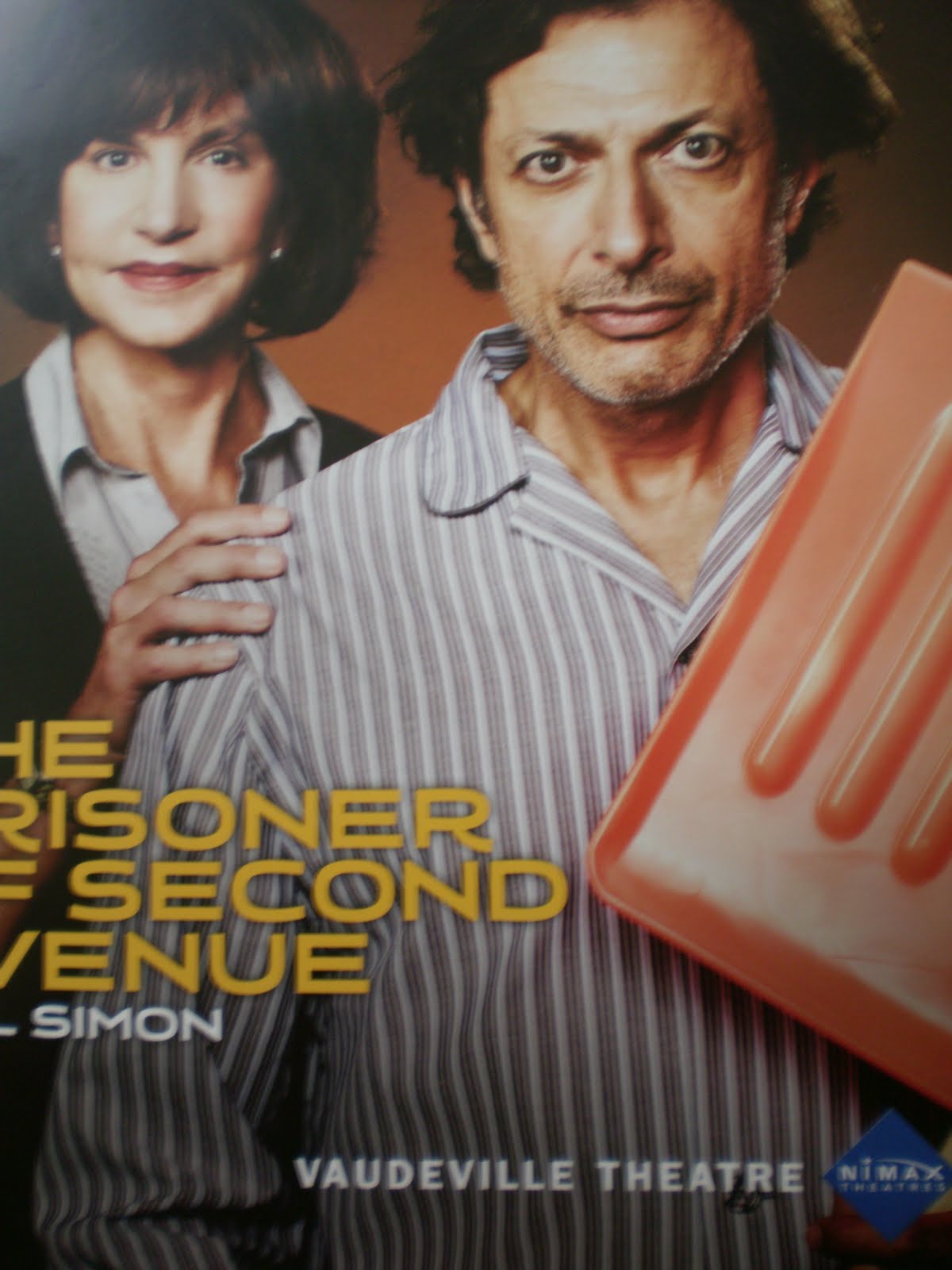
Funny in parts: Neil Simon's The Prisoner of Second Avenue at the Vaudeville Theatre


There's plenty in Neil Simon's play to chime with big-city dwellers and fans of with Woody Allen's films, replete with funny one-liners, and a hopeless shmuck in the lead. It's Death of a Salesman territory without Arthur Miller's gift for social analysis, or Alan Ayckbourn's plays transported to New York without the experimental approach to drama. Neil Simon's hero is not so much a victim of a situation as a whinger whose life fails to match his over-inflated hopes.

The play opens in Mel and Edna Edison's fourteenth floor New York apartment at 2am. Mel's insomnia, he says, derives from the gross inconvenience of big-city life: noisy neighbours, the smell funnelling up from the street and slipshod plumbing that causes the toilet cistern to run incessantly and the air-con not to function at all. His wife's role at this point is to act as a sounding board for his complaints and suggest he calm down and take some Valium. Along with psychotherapy and alcohol, according to Mel, they've been tried and failed. That there's something else bothering him is signalled by a plaintive: 'I don't know who I am any more'.

Next the apartment is burgled. 'You think they took the ordinary stuff and left the Chivas Regal?' says an exasperated Edna as Mel, as usual, is slow to come to terms. It turnns out the reason Mel couldn't sleep is he has lost his job to financial recession.


It's about here you recognise the parallel with modern times, the reason for reviving the play.The script, in the hands of a better playwright, (Miller, for instnace) would analyse and offer insights. But it doesn't. This isn't about how capitalism betrays then gobbles up the 'little man'; it's about how the family rally round to bail him out. Apart from a minor niggle about a accepting money from your financially more successful brother, it's problem solved.


The actors do their best with the superficially amusing dialogue. Jeff Goldblum is watchable but miscast, too rangy and goggle-eyed for the part of the put-upon Mel. (Although perfect as mad scientists in The Fly and Jurassic Park) Mercedes Ruehl's whiny Bronx accent reminded me of Marge Simpson; her character's saint-like patience irritated me, too. I kept wanting her to punch her whining partner. The repeated slapstick episode where the upstairs neighbour throws a bucket of cold water over him had the audience laughing a tad too cruelly, I thought.They were as fed up with him as I was.

The direction was a bit slow in parts, but I saw a preview. The set wasn't very good; the burgled apartment should have been much more denuded of possessions. I hardly noticed the TV and Hifi were missing.

Parallels with current concerns weren't clear. Maybe brother Harry (Linal Haft) and his thrifty sisters represent the Big Society that will rescue us all from market forces and that's the message we should take away. I didn't find it very likely or convincing.

Friday, July 02, 2010

Telling instead of Showing:The Phoenician Women at Theatro Technis


In fifth-century Greece, two brothers prepare to fight for sovereignty over 'Seven-gated Thebes'.Polynices has been brought an army from Argos, where he's lived for years in exile. He challenges Eteocles, who became ruler after their father Oedipus went mad and blinded himself. Having agreed at the time that they would take turns to reign for alternating years, Eteocles has reneged. Now Polynices threatens to destroy his native city unless Eteocles will back down. Their mother Jocasta enlists the help of Antigone, their beautiful sister, to make them see sense and not destroy Thebes.


The play was written by Euripides. It was a reminder of how Greek Tragedy achieved its so-called 'cathartic' effect,i.e. put the audience through the wringer, by imposing strict rules or 'unities' on the form of the play. The action must happen within 24 hours, which sets a pace as demanding as any modern thriller. Unity of theme demands the story concern an individual or small group, here the royal house of Thebes, concerned with one big issue,in this case patriotism.

The main strength, though, derives from the rule about unity of place, or having to stick to one location.

To describe a modern play as 'wordy' is to be critical, but it's the main component of Greek tragedy. Jocasta can plead with her sons within the palace grounds, but she has to fill in the backstory in a monologue, but the battle and its aftermath must be reported. It's a strangely hypnotic and compelling method that that requires a strong script and good actors. Fortunately this production had both - and all within a friendly fringe venue three minutes walk from Morning Crescent tube station.

Friday, June 25, 2010

Full Monty at the British Library


'Are these lockers safe?' an American woman asked me. 'They used to have guards'.

I directed her to the counter-service where you hand over your bags and coats, as in a museum. Using the locker room means you don't have to queue at the desk and you can access the locker easily all day. 'Yes, but are the guards to be trusted?'


I supposed it's marginally safer to hand in bags at the counter, although thieves would have to be very nifty to jemmy one of the lockers open, given the constant traffic. Since free Wifi and chair-desks in the public areas were installed it's very busy.

The forecast of high temperatures this week was my cue to spend a couple of days in the British Library. I'm lucky because I can travel easily from Lewisham to St Pancras, changing at London Bridge onto the highly superior trains that go to Bedford. It's a shame that leg of the journey is so short, especially as it includes a free copy of The Times.


I wasn't tempted to spend time in the courtyard but the fine weather makes for a lively scene, especially since they opened the cafe. Given my heat intolerance, and the need to do some background research for a short story, I headed for a nice cool reading room.


At lunchtime I like Chop Chop on the opposite side of Euston Road, past St Pancras Station. Clean, bright and air-conditioned, it offers main courses such as chicken with chilli and rice for only £3.30. An added bonus for me is listening to Chinese teenagers talking in Mandarin.


After lunch on Wednesday, I visited this small but beautifully presented exhibition about Spanish American Independence 1810-1860. It's on the first floor, and really helpful since I've begun to read Latin American short stories. Mostly set in turbulent times, they have lots of historical references. I think this exhibition deserves a blog of its own, so I'll do that later.


My cup was really running over on Wednesday, if you'll forgive the pun. I left the library at 4pm and crossed to the pub opposite to catch the exciting second half of the England v Slovenia match. Excellent atmosphere and I got a good seat in front of the big screen. It made such a difference, watching with a group of enthusiastic supporters I'm wondering whether to go there again for the England v Germany match.

Might visit the library again, as its open on Sundays.

Wednesday, June 16, 2010

Not Much of a Melting Pot: The Crucible at Regent's Park Open Air Theatre


The Crucible's never been one of my favourite plays and I avoided teaching it as an A-Level set text. But the offer of cheap tickets and a favourite venue- The Regents Park Open Air Theatre - convinced me to go along. I'm glad did.

Arthur Miller's play, inspired by Massachusetts witch-hunts in 1697,felt surprisingly at home. At an 8pm start, birdsong and a balmy June evening made a pleasant backdrop to the rural setting. By the end, huge trees, visible only in inky silhouette, helped create a mood of claustrophobic menace.


Miller found parallels between this story and the purges of the American entertainment industry in the late 1940s/early 1950s, when the House Un-American Activities Committee (HUAC) interrogated writers and directors. Fuelled by a frenzy of anti-Communist sentiment and the fear of conspiracy, investigators threatened suspected left-wing sympathisers with imprisonment or blacklisting. Immunity could be achieved by implicating others.

The play's theme of personal integrity versus a dogmatic regime is seen to be of universal relevance, which makes it popular. Despite the supposed recognition in places like post-Mao China, it has always seemed to me a particularly American play.


The production design is simple - a tilted house-facade provided trapdoors through which characters appeared as if at times from some infernal depths. The grassy area around the stage was often filled with bonnetted women murmuring and gasping as events unfolded. Emma Cuniffe was strong as the wife of John Proctor, the flawed hero who makes a stand against the religious bigotry of the time. Patrick O'Kane attracted sympathy as the man broken by an almost impossible choice, and the ensemble playing was adequate. It's unfortunate that the individuality of the characters isn't sufficiently realised.

Monday, May 24, 2010

Carmen at the O2


The passionate and beautiful Carmen, a gypsy factory worker, attracts rival lovers: soldier Don Jose and Escamillo, a bull-fighter. Initially faithful to the worthy Don Alonso, who for her sake deserts his post, Carmen succumbs to the local hero’s flashy charms. This being nineteenth century Seville,revenge ensues.

Christina Nassif in the skirt-swishing lead role seemed at times lost among the 100-strong cast and her voice lacked distinction. Elizabeth Atherton was outstanding as Micaela, the girl-next-door admirer of Don Jose. With mousy plaited hair and dull clothes, her subdued gestures and posture held attention and earned her the loudest final applause. Kevin Greenlaw was handsome in the fairly slight role of Escamillo and John Hudson was a stocky and sympathetic Don Jose, also cheered.


This was the very first opera to be staged at the O2 Arena, previously known as the Millennium Dome, normally hosting sell-put pop concerts. When I did presentationd to Travel and Tourism students in the run up to 2000, I explained the benefits to the local environment and transport infrastructure, in addition to providing a 'heritage' structure funded by lottery proceeds. When the right wing press bundled it with New Labour as a target any chance of a government-funded conversion was lost. The Dome was rescued from becoming a giant casino but it’s ironic that a project built with workers’ money now profits a multi-million global company.


A cross between a circus tent and an aircraft hangar, the best thing about the O2 Arena is its position, on a promontory jutting into the Thames. The reclamation of polluted land and its relative isolation from residential housing were factors that influenced the choice of the location for the Millennium legacy. Inside, it’s so big that that I doubt even binoculars would help identify the singers in the crowd scenes. It does allow, however, for the hugely ambitious stage for Carmen, an elongated serpent with two bulges in the middle.


One end of the giant S curled round the London Philharmonic Orchestra, doing full justice under conductor Gareth Hancock, to Bizet’ score. It excelled both in rousing set-pieces like ‘Toreador’ and in more subdued solo and duets between the principals. The space at the opposite end was by turns a tobacco factory, a night encampment and a bullring. The raised plane of the giant S in its wider centre served as the town square at noon, a place for lunch-break flirtation, and then a street café lit by strings of coloured bulbs for sultry evening trysts and knife fights. The snaking platform, aided by Andrew Bridge’s moody lighting design, was by turns a cat walk for factory girls, a dusty road for marching soldiers and a triumphal route for a procession that included fire eaters and somersaulting tumblers.


The programme was well worth the £6 price tag and included a plot synopsis and biography of Bizet, as well as articles on bull-fighting and the rise of the taste for verismo in operatic works. It is perhaps the latter that makes Carmen the most popular and most frequently performed opera. David Rogers contributed an interesting explanation for his design choices, in particular the death motifs celebrated in Spanish culture.


Thursday, May 13, 2010

Enron at the Noel Coward Theatre


‘Imagine if the belief that a plane could fly was the only thing that was keeping it in the air’.

Lucy Prebble’s play explores what happened in 1991 when an American energy supply corporation, apparently worth billions on paper, crashed with massive debts. Recent financial meltdown in some UK fiancial companies adds topical resonance.

Enron, with co-operation from President Bushes, Snr and George W, made huge profits selling energy in a deregulated market and then, when things began to go wrong, two employees invented cover-up schemes to fool auditors, shareholders and fellow workers. When the fraud came to light, the main victims were the workers, who lost pensions and investments to the tune of $1.32 billion when the company went bankrupt. The two men responsible tried to bail out in advance but were caught and faced hefty jail sentences.


It wasn’t just down to two men, though: ‘nobody who was supposed to say no said no. They all took their share of money from the fraud and put it in their pockets.’

Lucy Prebbles’s witty dialogue conveys the fatal atmosphere of corporate camaraderie while a clever plot shows a smug conspiracy of greed escalating towards disaster.


The triumph of the production is that an essentially boring topic like corporate procedure is made to seem intriguing and even exciting. It’s like ‘Yes, Minister’, transferred to Canary Wharf and jazzed up with music and dancing.

It’s all delivered with panache by a group called Headlong Theatre. The cast has changed from the original Chichester Theatre and Royal Court Theatre production but competently deliver a mix of secret top-level meetings dripping chicanery, surreal encounters and exuberant ensemble scenes.


The play’s big success is Anthony Ward’s design, with its multimedia, multi-level impact and the superbly orchestrated lighting effects by Mark Henderson. Brisk scene run-ons under Rupert Goold’s direction and some clever choreography combine with fantastic escapades where characters scuttle about in giant animal heads. Office clones with laptops are drilled to deliver numbers with a precision that echoes Busby Berkeley musicals or Fritz Lang’s classic 1927 film, ‘Metropolis’, about workers dehumanised by capitalism, all down to the troupe’s choreographer Ewan Wardrop.


So I’d say go, to experience a truly theatrical event, but read the programme first. As well as background to the story, it has a glossary that includes definitions, from the straightforward: ‘insider trading’,’ ‘hedging’ and ‘asset’ to the more esoteric: ‘Kool-Aid’, ‘Black Box’ and ‘SEC’

Enron at the Noel Coward Theatre : http://www.noel-coward-theatre.com/

Wednesday, May 05, 2010


'Hair' at the Gieldgud Theatre.

‘I can’t understand the words’, said my companion, halfway through a frenetic matinee at The Gielgud Theatre last week. The programme described the show as 'an ecstatic rock musical'. We were enjoying an interval respite from the noise and eating frozen yogurt in Berwick Street.

‘It’s not Andrew Lloyd Webber. The words don’t matter.’

Well, the words didn’t matter to whoever rehearsed the show's chorus – or ‘Tribe’, as they are called in the programme. The solos, mostly shrieked, weren’t much better. Of the 40 songs only two are still recognised - ‘Aquarius’, which never made much sense and ‘I got my Life’, ruined by association with TV Yogurt ads. The best song, and the only one where you can make out the lyrics, was written by Shakespeare, as a speech called ‘What a piece of work is man.’, here converted into a decent anti-war ballad.

This was almost the only genuinely moving part of the show, in contrast with the ear-splitting delivery of the rest. The young cast are unmistakably enthusiastic. There was a quite a bit of invasion of the audience, of the kind that makes you glad you didn’t sit too near the front. People around me were good-natured but nervous.

Unlike my companion I was happy enough to identify a parade of sixties themes: free love, pot smoking, racial prejudice, male display, anticommunism, street protests, the atom bomb, Eastern religions and the rejection of education and domesticity. A story of sorts emerged: a young man, his best pal and their girl friends drop out of middle class suburban lifestyles to live with a group similarly rebellious young people. Then one of them is drafted and sent to Vietnam, which brings everything to an end.

‘Hair’ seemed irrelevant here even when it first arrived from Broadway, in 1968. The pill had popularised unmarried sex in the early sixties in England. Although we might deplore the war in Vietnam: ' white people sending black people to fight yellow people for those who stole it from the red people’, as one of the characters puts it, nobody mentioned a ‘special relationship’ back then. The show’s big draw was nudity onstage, recently allowed by the abolition of the Lord Chamerlain's role in censoring theatre.

Rado and Ragni's show was a hit in London then; 'Time Out' named it last week as London's top musical. I didn't see it first time round, so it was a good opportunity, being tied up at the time with amateur drama and motherhood in Penge, so this seemed a good opportunity to see what I'd been missing.

The programme says that this version, which is not the first revival, has been updated, but unless you remember the original it’s not always clear where. There’s an 'ad-lib' stand-up comedy at the beginning performed by one of the characters, and ‘contemporary’ references, such as Roman Polanski’s name called out at random moments. Comedy scenes, like the one with the hero’s stereotyped suburban parents and another with a conventional middle aged couple apparently plucked from the audience were so inept as to be embarrassing. They were not so annoying, however, as the audience ‘plants’ who made their raucous presence felt in the second half and who led the orchestrated ‘standing ovation’.

The single funny line is made by the hero’s father. When his son expresses the wish for a change of nationality, in a song called ‘Manchester, England’, he says, ‘Face it, you’re Polish!’.

For all the supposed boldness of songs like ‘Sodomy’ which nowadays sounds just like a childish list of rude words, nudity is underplayed, making a brief appearance just before the interval. The cast move towards the back of the stage, the lights are lowered and they drift off to reappear and stand without clothes. It’s like an old-fashioned Music Hall tableau, all done in the best possible taste.

‘Hair’ reminds me of all those ‘I love you, Dad’ scenes in American movies. As we sneaked out of the theatre, not tempted to join the cast onstage, I was feeling not so much ecstatic as old. In fact, I felt something like the Duchess of Malfi when the madmen ceased their torments. And I had to agree after all that we should at least have been able to understood the words.


'Hair' at The Gielgud Theatre: www.gielgud-theatre.com

Wednesday, April 21, 2010

The Duchess of Malfi at the New Players Theatre


Circus as metaphor for John Webster's anarchic world has a lot going for it. Intrigue and deceit generate mental acrobatics on all sides. With five corpses piled onstage at the end and a lot of gruesome surprises on the way, the overheated tragedy is replete with spectacle. The Italian setting invites comparisons with Comedia del'Arte and designer J William Davis' set and costumes were convincing. Sadly, they detracted from the overall impact of the play.

I was lucky enough to see Judi Dench and Helen Mirren give powerful performances onstage in London.Both brought out the resonance of 'I am entering a wilderness' , as the heroine decides to defy her brother , and the dignity of 'I am the Duchess of Malfi still' when calumny follows.

I 'd been curious for a while about visiting this theatre under the arches near Charing Cross that's better known for late night risqué cabarets than classical plays.

In seventeenth century Milan the widowed Duchess of Malfi is forbidden to marry by her excitable brother Ferdinand. He engages the cynical Bosola, ‘the only court gall’ to keep an eye on her while he’s away. The Duchess is in love with one of the few good men around, Antonio. His status as a groom makes him a bad match, but they go through a form of secret marriage and have three children before Ferdinand finds out.

Webster’s image-filled language was as superb and arresting as ever, the lines echoing recent usages, such as ‘Cover her face, mine eyes dazzle. She died too young’. or ‘Pleasure of Life, what is it? Merely the good days of an ague’. Webster’s themes - high-level corruption and male oppression – also account for its continuing popularity. It was good to be reminded at the present time that: '‘A politician is the devil’s quilted anvil’.

At first, the spare big-top set, with hurdy gurdy music, actrobatic scurrying up ropes and twirling hoola hoops was a pleasing novelty. The play opened with a wrestling match and ribbon-like ropes were used by extras to scatter paper snowflakes on th e exiled lovers. As the programme made clear, the company, appropriately named Vaulting Ambtion', was well- trained in circus arts.

There were too many occasions, though, when the production was over-strained Although the circus performers were mainly distanced from the action, except for the successful 'mad torment' scene, the concept jarred, despite Dan Horrigan's brisk direction. Dressing Tilly Middleton, the Duchess, for instance, in a sequinned mini-dress and a pony-tail hair-style topped with a pink scrunchy made it hard to preserve any sense of dignity. Her performance came across as dispirited when it should have been tragic.

The acting, it must be said, was generally lack-lustre, but as there were only seventeen of us for the matinee in the tiny theatre, it was perhaps unsurprising. What should have been shocking parts of the play - the severed hand and the poisoned book, the murders and even the waxen show were all understated and lost impact

In the stock seventeeth century role of ‘malcontent’, James Sobol Kelly 's Bosola was good , as the servant whose unrewarded merit has made him turn to evil, akin to Shakespeare's Iago. Here he's working, at least initially, under orders from above.

One of the most puzzling moments is when the Duchess’s maid, Cariola, delivers a jazz chorus from half-way up a ladder. Stephanie Brittain's cabaret delivery was pleasant, but the choice of ‘Honeysuckle Rose’ pointless. It wasn’t as if it was designed to drown out the occasional sound of trains passing overhead. Another bizarre touch was the use of coathangers with small suits attached to represent the Duchess's doomed children. In another context it would have seemed inventive.Here it just added to the general clutter of a somewhat confusing the production.

Tuesday, April 06, 2010

In Retro-respect: Alan Ayckbourn's Bedroom Farce at The Duke of York's


It's the 70s; Nick and Kate are throw a house-warming party. Nick's DIY ineptitude means shelves fall down and the walls are half-papered but nothing bothers this loved-up pair who run round hiding shoes for a laugh. Nick's slightly cross that Kate has invited Susannah and Trevor, whose marital spats are routinely played out in public. It's a shame that Jan, Trevor's ex, will be there too, on her own because husband Malcolm is in bed with a bad back. Meantime Trevor's elderly parents go out to celebrate their anniversary then settle down for a bedtime snack. Mayhem ensues and nobody gets much sleep.


I wonder what it must be like for people who didn't know the 70s to watch this play. True, people still struggle with flat-pack furniture, one target of Ayckbourn's soft-centred satire, and the English middle-class fear of rows is just as strong, but those coats-piled-on-bed parties are a distant memory. These days guests don't bother with coats, or leave them in the car.

As with most of Ayckbourn, the joy is in the play's inventive use of the stage and witty dialogue as well as the dovetailing of the three-stranded plot. When I first saw this in the 70s it seemed daring to set the action entirely in three contrasting bedrooms. Even now I seem to remember a revolving stage for the first London production. At the Duke of York's it's all done with lights.

With Peter Hall directing, this entertaining tranfer from Kingston Rose Theatre was slick but not quite settled in on the night I attended. The younger couples seem a tad dated, the silly newly-weds like the Catherine Tate couple who laugh like drains when they get out of the lift at the wrong floor. Kate (Finty Williams) is bouncy and Nick (Tony Gardener) not quite hapless enough.Slipped-disc Malcolm (Daniel Betts) does a great slow-motion fall out of bed when he drops his book, and Jan (Sara Crowe) deftly portrays the wife whose patience is wearing thin.

My favourites, then as now, are parents Delia (Jenny Seagrove) and Ernest (David Horovitch) the actors as comfortable on stage as they are with their stereotype middle class marriage, mildly amused that eating pilchards in bed makes it 'smell like a fishing boat.'

It's not one of Ayckbourn's funniest plays, having the hall-mark surface frivolity without the dark undertones of later works, such as 'Woman in Mind' seen in the West End last year. It still slips down like a smooth Amontillado. I imagine it would chime more with a posh suburban audience than the West End one, but there's still a lot to like. Especially if you remember the 70s.

Monday, March 15, 2010

Churchill’s studio at Chartwell.


‘And the moon shines bright on Charlie Chaplin
His boots are cracking for t' want of blacking
And his old fusty coat is wanting mending
Until they send him to the Dardanelles’

In 1915, when this sang mildly satirical ditty was first heard, Sir Winston Churchill took up painting.

His wife, Clementine, did all she could to encourage Winston’s new hobby. He’d suffered from depression for years and the failure of the Dardanelles campaign, for which he was blamed, was a time of national mourning. She even called on artist and family friend Sir John Lavery to help the great man. Given his well-known irascibility, that must have taken courage. Churchill apparently ignored advice to tone down his hues.

After a false start with water colours, he completed over 500 oil paintings over his lifetime. About 350 are still at his country house, Chartwell, now owned by the National Trust, some in the house itself but most in the studio he had built in the grounds.


Last Sunday’s Spring-like weather made the prospect of hour’s drive from South London through Kent very tempting. It would have been an hour, if we hadn’t been diverted round Sundridge.

Mothers’ Day coincided with Chartwell’s opening for the Trust’s 2010 season, so I shouldn’t have been surprised that parked cars spread into a reserve field and the restaurant had run out of chicken cobbler. It, crowded, noisy, messy and overrun with children. We wished we’d stopped at one of the pubs in Brasted instead.

I’d enjoyed previous visits to the house, full of Churchill memorabilia and an exhibition about his military achievements. Today I wanted to see the paintings and we were just in time to catch a three o’clock introductory talk.


Churchill made no claims for the quality of what he called his ‘daubs’ and it’s just as well. Possibly the best ones are in private collections elsewhere, and a couple in the National Gallery were mentioned. The paintings are mainly landscapes – scenes from the Kentish Weald farm where Churchill lived before moving to Chartwell and the grounds near the house itself. The majority showed French, Italian and Moroccan locations he visited on holidays and campaigns.


Interesting as the domestic interiors and the paintings are, the real star of the show is the Kentish landscape surrounding the house, situated on a small promontory overlooking a valley. Ponds, for swimming and fishing, border the sloping lawns, beyond which fields merge with wooded hillsides, resembling pastel sketches in subtle greys, reddish browns and soft purple. The spears of daffodils, bright green among the bracken and rocks near the house, contrasted with the dead ribs of giant ochre leaves in a huge patch of rhubarb-like plants near the house.


‘A day away from Chartwell is a day wasted’, Churchill said. The peace and stillness here must have helped him forget the turmoil of war that haunted him. It’s certainly a place to inspire a budding artist as well lift the spirits of visitors.

About the National Trust: www.nationaltrust.org.uk